Guide
Dating App Development Guide: Process, Cost, Features & Challenges
Do you have a unique idea and want to build a dating app like Tinder or Bumble? Good. The market has room for it.
As of right now, there are 360 million to 380 million people using dating apps worldwide; with that number, it is understandable why smart investors like you want to enter this industry and make their app user favorite.
Now, businesses don’t just ask, “How do I build a dating app?’, They now ask, “How do I make people stay, trust it, and pay for it?’
This dating app development guide answers what your normal Google search query couldn’t, here you will get to know about strategies to build a dating app, a growth plan, and the revenue model of a dating app.
What is Dating App Development?
Dating app development is the process of creating a unique platform where people can discover, match, and talk to others who share same relationship goals. It covers everything from planning and design to coding, testing, and launch.
A dating platform usually works through different interfaces:
- User Interface: First is the user panel, where users access it and should be able to create profiles, browse matches, and chat.
- Admin Dashboard: It is the interface that’s accessed by the admin, where the business team manages users and moderates content on the platform, removes/adds users, and tracks revenue.
The process of developing a dating app covers every stage, from clean UI/UX design and smart matching logic to secure messaging and a reliable backend.
The final step is launching the app smoothly across iOS and Android.
Some top apps are Tinder, Bumble, Raya, Grindr, and others, which are inspiring investors to build a dating app.
One thing to keep in mind is that building a dating mobile app should deliver an experience that feels comfortable and human. It must ensure that users don’t just download the app; they come back.
Overview of the Dating App Development Market
The dating app market is at an all-time high, and in the future it’s going to be a billion-dollar industry.
Don’t you believe us? Here are stats along with sources to back it up:
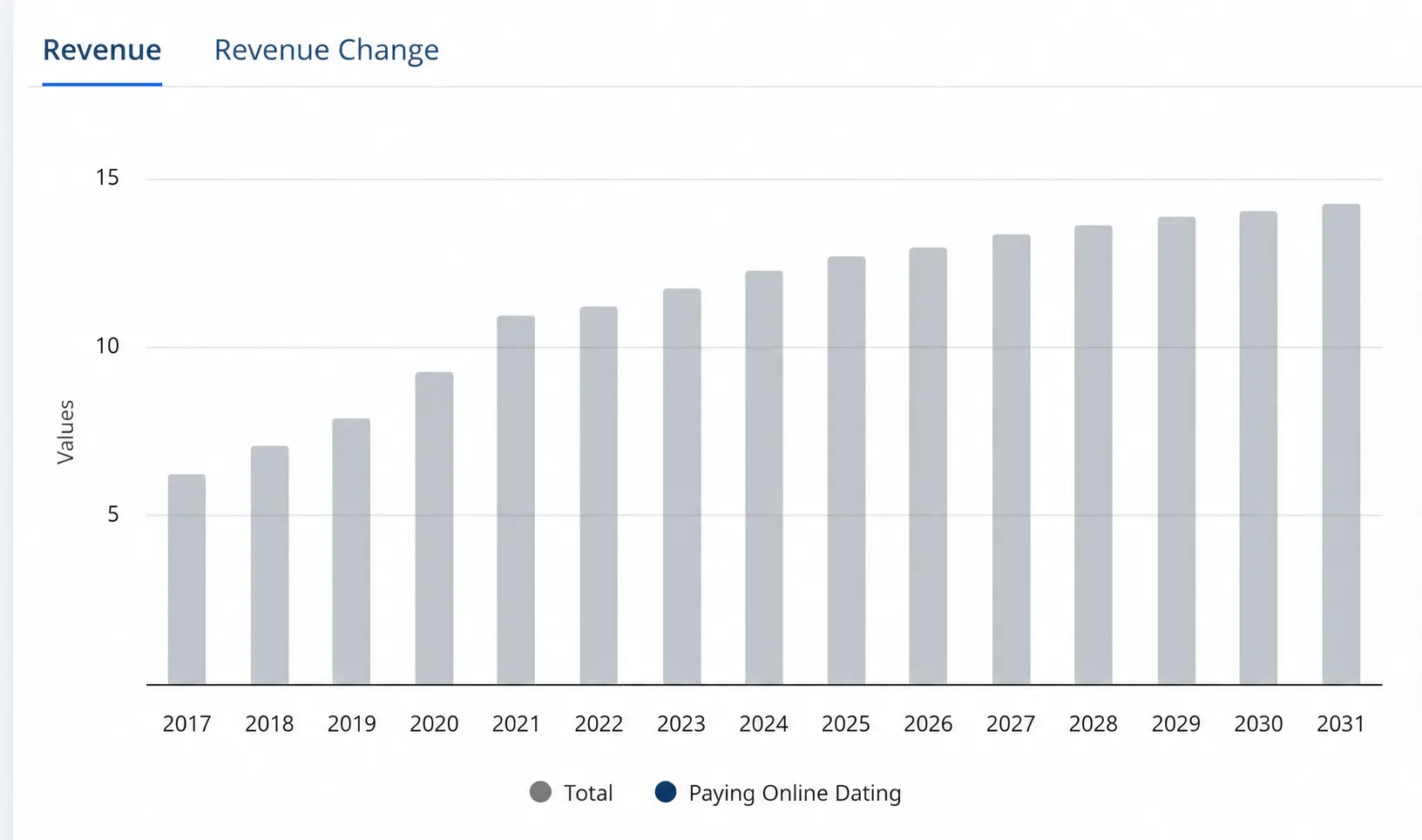
- Market Revenue: The global online dating market is projected to generate US$3.25 billion in 2026.
- Market Growth: Revenue is expected to grow at a 1.87% CAGR from 2026 to 2031, reaching US$3.57 billion by 2031.
- User Base: The market is projected to reach 452.1 million users by 2031.
- User Penetration: User penetration is estimated at 5.3% in 2026 and is expected to reach 5.5% by 2031.
- ARPU: Average revenue per user is projected to be US$7.80.
- Top Revenue Market: The United States is expected to generate the highest revenue at US$1.45 billion in 2026.
- Highest User Penetration: Belgium is projected to have the highest user penetration at 19.7%.
Without a second thought, tech is changing the industry. Now, the market is driven by AI-driven matching, smarter recommendations, and better safety tools.
Major leaders are investing heavily here. And the competition? Intense. Tinder led downloads in 2026. Bumble followed close behind.
For founders, this means one thing. Big opportunity. But only if their product actually stands out.
Types of Dating App Development
Before you create a dating app, you need to decide which type fits your audience.
Each type changes how profiles look and how users match. In the end, your choice affects the design, features, budget, and the way you earn from the app.
Here are the main types to consider:
- Swipe-Based Dating Apps: Users swipe through profile cards to like or pass, and a mutual like creates a match. Tinder is the best-known example.
- Prompt-Based Dating Apps: Profiles are built around written prompts and photos, so users can like or comment on a specific answer. Hinge follows this model.
- Niche Dating Apps: Built for a specific group, such as a religion, profession, or interest. Muzz is one example.
- LGBTQ+ Dating Apps: Designed with inclusive gender and orientation options, along with extra safety controls. Grindr and HER are well-known names.
- Video Dating Apps: Users connect through live video or short video profiles before meeting in person.
- Audio Dating Apps: Voice-first apps where people talk before seeing photos, which lowers pressure on looks.
- Senior Dating Apps: Made for older users, with larger text, simple navigation, and fewer gestures.
- AI-Based Matchmaking Apps: Use AI to suggest matches based on personality, behavior, and compatibility. Iris Dating is one such example.
- Elite or Membership-Based Dating Apps: Access is limited through screening or paid membership. Raya and Luxy follow this approach.
Now, with that being clear, it is high time to understand how to build a dating app of your dreams. Let’s explore that in the next section.
Have a Dating App Idea But No Clear Roadmap?
Our team plans, designs, and builds dating apps that users stay on after the first week.
Step-by-Step Process to Make a Dating App
Ready to turn your idea into an app people actually swipe on? Here is the dating app development process, step by step, from the first sketch to the day you go live.
Let’s jump right in:
Step 1: Validate the Idea Before You Spend
Before you hire anyone, check whether your idea deserves money. Dating is a crowded market, so “another Tinder” is a hard sell.
Ask yourself:
- Who is this app for, and what do they lack today?
- Why would they leave an app they already use?
- Is there a niche the big apps ignore?
Well, gathering user feedback is important for dating apps. Some things you can try are to ask people about their experience with the different apps. You can read negative reviews on popular apps such as Tinder, Bumble, Raya, HER, and Grindr and understand the gap in the market.
Their answer will tell you if your idea is good or not, and it cost you nothing compared to a failed launch.
Step 2: Decide How the App Will Earn
As the investor, you need to know where the money comes back from. This decision also affects the product, because it decides where limits and upgrade prompts appear.
Common models:
- Subscriptions: Paid tiers with extra likes, filters, or visibility
- In-app purchases: Boosts, super likes, or gifts
- Advertising: Works best at larger user volumes
- Hybrid: Free base with optional upgrades
Keep the free version useful. If people feel blocked at every step, they leave before they ever pay. Choose one primary model for launch and add others later.
Step 3: Set Your Budget and Timeline
Here comes the important part: Time to analyze the overall cost to build a dating app and finalize its timeline.
You need to plan for design, development, testing, server costs, moderation, and marketing.
Break your budget into phases:
- Discovery and design
- MVP development
- Testing and launch
- Marketing and first six months of upkeep
You should keep a percentage of 15 to 20 percent for changes and surprises. Ask for fixed-scope quotes with clear milestones, so you know what you pay for at each stage.
Step 4: Develop Your Dating App
Once the design is approved, your chosen mobile app development company turns it into a working product.
This phase requires proper collaboration between you and your chosen team. Good teams build in short cycles called sprints, usually two weeks each, so you see at the end of every cycle and can change direction early.
The core build includes:
- User sign-up and profile setup
- Matching logic and discovery feed
- Real-time chat and push notifications
- Location features and filters
- Admin dashboard for moderation and analytics
Ask for a demo build after every sprint and test it yourself. Catching a problem in week four costs far less than finding it in week twelve.
Step 5: Build Safety, Privacy and Legal Cover
Dating apps handle photos, locations, and private chats. A privacy failure can damage your brand quickly, and legal problems can stop a launch.
Plan these from the start:
- Verification: Selfie or ID checks to reduce fake accounts
- Moderation: Tools and people to review reports
- Privacy compliance: GDPR, CCPA, or local data laws, based on where you operate
- Age controls: Strict 18+ checks
- Policies: Terms of service and privacy policy reviewed by a lawyer
App stores also review dating apps more closely, so these items affect approval.
Step 6: Test, Then Launch Small
Before the public sees your app, run it through serious dating app testing.
In this phase of dating app development, the functionality and operation of dating apps are checked on different phones, slow networks, payments, location accuracy, and data security.
Then invite a small beta group from your target audience.
Launch in one city, or one niche community. A small active pool gives better matches than a large empty one.
Track:
- Sign-up completion rate
- Time to first match
- Match-to-message rate
- Day 1, Day 7, and Day 30 retention
Let these numbers tell you what to fix before you spend on expansion.
Step 7: Market the App and Win Your First Users
An empty dating app is what loses money.
People only stay when they see others, so build your first user group on purpose.
Ways to bring in early users:
- Pre-launch waitlist: Collect sign-ups before release
- Short video and social media: Show what makes your app different
- Creator partnerships: Work with people your audience trusts
- Campus or city events: Concentrate users in one place
- App Store optimization: Clear keywords, screenshots, and reviews
- Referral rewards: Give users a reason to invite friends
Watch the balance between groups, such as men and women, since lopsided communities lose users quickly.
Moving forward, we are going to talk about the features of your dating app that can help you succeed in the market.
Essential Features to Have in a Dating Mobile App
Want to keep users on your app? Well, features are important to ensure the user experience and retention always remain high.
We are going to explore different types of panels along with their features:
- User Panel
The user panel gives members everything they need to discover matches and communicate, manage profiles, and control their dating experience.
- Profile Creation
This feature is important to offer users everything they need to discover matches, communicate, and find companionship.
- Personalized Dashboard
Each user sees their recent activity and saved items along with suggestions based on what they are browsing.
- Smart Search
Powerful filters and category sorting help users reach the exact product or service they are looking for.
- In-App Messaging
Once matched, users can easily chat with each other, get to know each other, and share files without leaving the platform.
- Real Chat Notifications
Instant push and email alerts inform users about every update, reply, and important account activity.
- Secure Payments
Multiple payment methods with end-to-end encryption at checkout make every transaction safe and completely hassle-free for users.
- Profile Management
Users can update personal details, they can change privacy settings, and control how often they receive platform notifications.
- Ratings & Reviews
Genuine ratings and written reviews from real users help the community make better and more confident decisions.
Admin Panel
Admins get complete control over the entire platform without touching a single line of code anywhere.
- Central Dashboard
A single screen shows total users, revenue, traffic, and engagement so admins understand platform health instantly.
- User Management
Admins can view, verify, suspend, or permanently delete any user account directly from one simple screen.
- Content Control
Every listing, post, category, and media file can be added, edited, approved, or removed within seconds.
- Revenue and Payouts
Admins can track all earnings, set commission rates, and check any kind of financial reports anytime.
- Role-Based Access
Specific permissions can be assigned to each staff member so sensitive modules stay protected from unauthorized access.
- Analytics and Insights
Detailed reports on growth, user behavior, and conversions help admins take faster and smarter business decisions.
- Marketing Tools
You can offer different tools, promotions, discount codes, and banners that can all be launched without any developer help required.
- Platform Settings
With this feature, you get to change platform rules, languages, and gateway settings anytime and see updates reflected everywhere instantly.
Moderator Panel
Moderators get a focused workspace built only for keeping the platform clean, safe, and fully policy compliant.
- Report Queue
Every reported post, comment, and profile arrives in one organized queue ready for quick moderator review.
- Content Actions
Moderators can approve, edit, hide, or delete any flagged content while the system logs every action.
- Spam Filters
It is not possible to create a dating app without spam filters, which highlight risky content before it even reaches a single real user.
- Warnings and Bans
Moderators can issue warnings and temporary suspensions while recording the exact reason behind it.
- Appeal Handling
Users who feel wrongly penalized can appeal, and moderators review and restore their content when justified.
- Live Monitoring
Ongoing chats and comment threads are monitored continuously for abuse, harassment, scams, and clear policy violations.
- Performance Reports
Daily reports show resolved cases, average response time, and accuracy, so moderation quality stays consistently high.
Dating App Revenue Models: A Quick Guide
Building a dating app is the easy start; making it profitable is where most founders truly struggle.
Dating apps can make money through different means such as freemium, in-app purchases, advertising, and many more.
Below are five proven revenue models, how each one works, and when it makes sense to use them:
1. Subscription Plans (The Core Revenue Engine)
Subscriptions are the backbone of almost every successful dating app.
Users pay a recurring weekly, monthly, or yearly fee to unlock premium features while the free version stays limited but usable.
This model works because it creates predictable monthly revenue instead of unpredictable one-time spikes.
What you typically lock behind a subscription:
- Unlimited swipes and likes
- Seeing who already liked your profile
- Advanced filters like height, education, religion, or lifestyle
- Rewind or undo an accidental left swipe
- Ad-free browsing experience
Best for: Apps with a large, active user base and strong daily engagement. Watch out for: Keeping the free version too weak kills growth. Users must experience real value before they are asked to pay.
2. In-App Purchases and Virtual Currency
Not every user wants a monthly commitment, and this is where one-time purchases work beautifully.
Users buy credits, coins, or individual boosts whenever they need them, which makes spending feel casual rather than like a subscription decision.
Common purchasable items:
- Profile boosts that push you to the top of the stack for 30 minutes
- Super likes or priority messages that stand out in someone's inbox
- Virtual gifts such as roses, hearts, or stickers sent during chat
- Extra daily swipes once the free limit is exhausted
- Read receipts showing whether your message was seen
Best for: Apps with a younger audience and casual users who dislike recurring payments.
Watch out for: Overloading the app with purchase prompts makes it feel like a slot machine and damages trust.
3. Freemium Model with Feature Gating
Freemium sits between free and paid. The entire app is free to download and genuinely usable, but the features that save time and increase match quality sit behind a paywall.
Done right, this model turns your free users into your best marketing channel while a small paying percentage funds the whole operation.
How feature gating usually works:
- Free users get limited daily matches; premium users get unlimited
- Free users wait in the queue; premium users get instant visibility
- Basic chat for everyone, video calling and voice notes for paying members
- Location search restricted to your city unless you upgrade to travel mode
Best for: New apps that need volume first and revenue second.
Watch out for: The free tier must solve a real problem on its own, otherwise users uninstall before converting.
4. Advertising and Sponsored Content
Advertising monetizes the users who will never pay you a dollar.
Instead of pushing them to upgrade, you earn from their attention through native ads, sponsored profiles, or brand partnerships with restaurants, event organizers, and lifestyle brands that fit the dating context.
Advertising formats that work in dating apps:
- Native ad cards that appear between profile swipes
- Rewarded video ads that give a free boost or extra likes in exchange for watching
- Sponsored events, speed dating nights, or brand-hosted meetups
- Affiliate tie-ups with restaurants, flower delivery, gifting, and travel brands
Best for: Apps with high daily active users and a large non-paying base. Watch out for: Intrusive ads directly interrupt the emotional experience of matching, so placement matters more than volume.
5. Premium Matchmaking and Niche Services
This is the highest margin model and the most underused.
Instead of selling features, you sell outcomes–verified profiles, human-assisted matchmaking, background-checked members, or an exclusive community that users apply to join.
Serious, relationship-focused users pay significantly more for curation than they ever will for extra swipes.
What you can charge a premium for:
- Manual matchmaking by a real relationship consultant
- Identity, income, or background verification badges
- Invite-only or application-based elite membership tiers
- Profile review, photo selection, and bio optimization services
- Offline curated events for verified members only
Best for: Serious dating and matrimony-focused platforms targeting an older or higher-income audience.
Watch out for: This model needs operational manpower, so margins look great only when the process is partly systemized.
How Much Does it Cost to Develop a Dating App?
Before investing a single dollar, you should understand the dating app development cost.
On average, a founder needs to spend $5,000 to $120,000+.
A simple swipe-and-match MVP with basic chat can be at the lower end, while an AI-powered platform with personalized matchmaking and admin tooling can easily push past $ 120,000+.
More than anything, dating app development costs increase because of three things.
- How many features you build.
- Whether you go for native or cross-platform development
- Where your development team is located
An hourly rate in North America can be five to six times higher than in Asia for the same scope of work, which is why the same app can be quoted in the thousands by one agency and millions by another.
Here is a complete breakdown by app type:
| App Type | Features Included | Timeline | Estimated Cost |
|---|---|---|---|
| Basic MVP | Sign-up, profile creation, swipe matching, basic chat, simple admin | 2–3 months | $8,000 – $20,000 |
| Standard App | MVP features + filters, push notifications, payments, subscriptions, moderation panel | 4–6 months | $20,000 – $45,000 |
| Advanced App | Standard + video calling, voice notes, geolocation matching, boosts, analytics dashboard | 6–9 months | $45,000 – $80,000 |
| Enterprise Grade | Advanced + AI matchmaking, ID verification, multi-language, offline events, custom admin suite | 9–14+ months | $80,000 – $120,000+ |
You need to hire an experienced mobile app development company in the US, Europe, the UK, and many other regions to get a clear estimate of your idea.
Planning to Launch a Dating App this Year?
Share your concept and get a clear estimate on features, timeline, and cost.
Things to Keep in Mind While Developing a Dating App
It might sound easy, but it comes with lots of complications. We are about to do a deep dive into the issues and solutions for building a dating app.
Dating App Design Spam
One of the huge issues at the current time is surpassing the iOS approval process for dating apps, which is caused by the same design and features.
Solutions:
- Apple flags copied interaction patterns, so experiment with prompt-based matching, voice intros, question cards, or curated daily matches.
- A custom color system, typography, iconography, and screen layouts separate your app from the cloned builds Apple rejects under guideline 4.3.
The Cold Start Problem
A dating app is worthless without users, but nobody joins an app with no users.
Investors often fund a polished product that launches to an empty database, and the first thousand users churn within a week because there is nobody to match with.
Solutions:
- Launch city by city instead of spreading thin across the country
- Run offline events and campus activations to seed real local users
- Partner with influencers and communities who bring their own audience along
3. Trust, Safety, and Fake Profiles
Bots, catfishing, and scam accounts destroy user trust faster than any missing feature.
One bad experience and users uninstall permanently, leave negative reviews, and warn their friends away from the platform.
Solutions:
- Make photo and ID verification mandatory before any profile goes live
- Deploy AI moderation to catch scam patterns and inappropriate content early
- Remove flagged accounts quickly and communicate action taken to reporters
How to Choose the Right Dating App Development Company?
Before signing any contract, every investor types the same thing into Google: how to hire the right dating app development company.
Three qualities you can look for:
- Proven experience with dating and social platforms
- Safety and moderation built into version one rather than bolted on later
- A partner who challenges your scope instead of silently quoting it.
This is exactly how AptenTech approaches a dating app build: custom matching logic, verification and moderation from day one, and a monetization model mapped out before the first screen is designed.
With marketing and SEO handled in-house, the conversation continues well past launch day.
Conclusion
Building a dating app starts long before development. You need solid market research. You need a niche worth owning.
And you need a monetization model decided early. The build itself rarely kills a dating app. What kills it is an empty user base or a broken gender ratio.
Fake profiles do the same damage. So does a rejected app store submission. Budget realistically from day one.
Expect to spend as much on acquiring users as on building the product. Treat safety and moderation as launch-day features rather than future upgrades.
Most importantly, choose a development partner who has shipped in this category before. Get these decisions right early. The technology then becomes the easiest part of your entire journey.
FAQs
You can use mandatory photo and ID verification. Add AI moderation to flag suspicious accounts before they reach real users.
You need to build original designs and features. Once done, make sure to add verification, reporting, and moderation before submitting. Avoid cloning existing dating app layouts.
On average, the dating app development cost can range from $5,000 to $120,000+. The cost can increase or decrease based on your project requirements, design, and other factors.
Start with a freemium base to grow your user count. Add subscriptions once engagement is steady, then introduce boosts and in-app purchases.
Giving a rough number is hard. A basic MVP takes around 2 to 3 months. An AI-powered dating app with video calling and AI matching can take 6 to 9+ months.